There are places you visit. And there are places you live.
The Mesopotamian Marshes, known in Arabic as Al-Ahwar, belong to that second category. In the far south of Iraq, where the rivers Tigris and Euphrates have shaped for thousands of years a landscape of water, reeds, islands and canals, there exists a way of life that seems to belong to another time.
Here, boats replace roads on many journeys, water buffaloes are part of the landscape, traditional houses are built with reeds, and the rhythm of life remains deeply tied to the water.
But the marshes are much more than a pretty landscape.
They are part of the most ancient history of Mesopotamia, are linked to the birth of some of humanity's first cities and preserve a traditional culture that has survived decades of hardship.
And perhaps because of that, when a traveller arrives for the first time, the reaction is usually one of surprise.
One of my clients, after visiting the salt marshes for the first time, told me:
“How little Iraq is promoted. I didn't know it had this natural wonder.”
I think that phrase perfectly sums up what happens when you discover this part of the country.
What are the Mesopotamian Marshes?
The Mesopotamian Marshes they are a massive wetland system located in southern Iraq, around the area where the waters of the Tigris and Euphrates converge.
The Arabic term Ahwar refers precisely to these wetlands.
For thousands of years, water has shaped the landscape here, as well as the lives of its inhabitants. In a region that we now easily associate with desert and high temperatures, finding a freshwater ecosystem, abundant vegetation and extensive areas of reeds feels almost surprising.
UNESCO describes the Ahwar of southern Iraq as one of the world's great inland delta systems in an extremely hot and arid environment. The site inscribed as World Heritage is made up of seven components: four wetland areas and three archaeological sites: Uruk, Ur and Eridu.
It is precisely this combination that makes the marshes so special.
Here, nature and civilisation are connected.
A landscape tied to the birth of civilisation
To understand the current marshes, one must go back thousands of years.
Long before current country borders existed, this region was the heart of ancient Mesopotamia.
Enter approximately the 5000 and 3000 BC., changes in sea level and in the region's hydrology caused the marshy areas to extend much further inland. On their edges, some of humanity's first major urban centres emerged.
Among them we find Uruk, Ur and Eridu.
Uruk is associated with some of the earliest urbanisation processes and the development of writing. Ur became one of the great centres of ancient Mesopotamia, and Eridu is considered one of the oldest known cities in the region.
Therefore, it is no exaggeration to say that, when we navigate the marshes today, we are traversing a landscape that was linked to some of the earliest chapters in the urban history of humankind.
Water as the origin of a civilisation
Rivers were not simply a source of water.
They allowed for farming, fishing, transporting goods and connecting communities.
The reeds that grew in the wetlands provided materials for building homes, boats, mats and numerous everyday objects. UNESCO notes that the resources of the marshes were of fundamental importance to the communities of ancient Mesopotamia and that reeds formed an essential part of their material culture.
In other words:
The same landscape that we contemplate today from a small boat helped to provide the resources necessary for one of the first great civilisations to prosper.
The marsh-dwellers: a way of life linked to water
For generations, communities known as Marsh Arabs they developed a way of life completely adapted to this environment.
Their relationship with water is not a tourist activity. It is a way of life.
Fishing, agriculture, water buffalo breeding, dairy production, navigation and reed harvesting have traditionally formed part of the economy and daily life of these communities. The United Nations highlights precisely this close relationship between the inhabitants of the marshes and the natural environment: gathering reeds, making mats, building houses, fishing, breeding buffaloes and making qaimer are activities deeply linked to the ecosystem.
And there is something especially interesting:
many of these activities use resources provided directly by the landscape itself.
Nature is not separate from life. It is life.
Reeds: much more than a plant
When visiting the Mesopotamian marshes, the reeds are one of the most striking elements.
They create authentic natural corridors over the water and form large expanses of vegetation.
But for local communities, they have a much greater value.
Reeds have traditionally been used to build homes, mats, decorative elements, furniture and even boats.
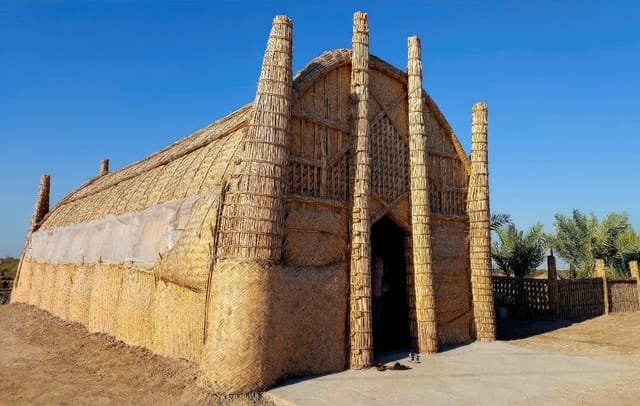
And among all the structures, one stands out as especially spectacular: the mudhif.
The mudhif, the great marsh house
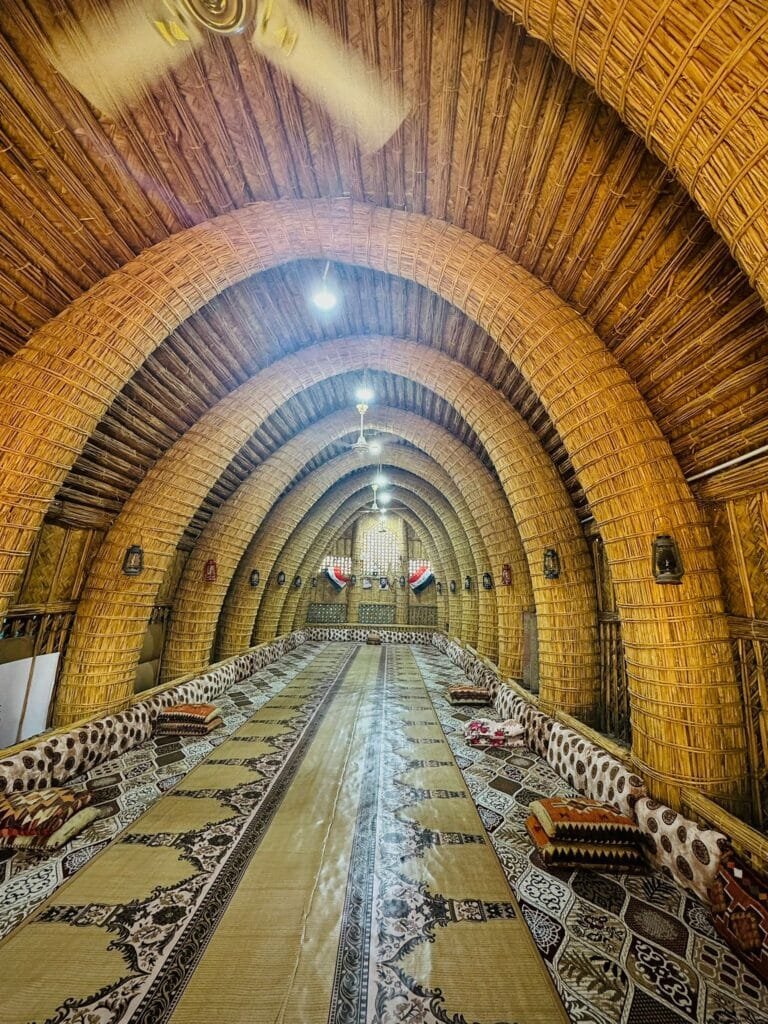
If there is one structure capable of summarising the culture of the marshes, it is the mudhif.
At first glance it looks like a huge arched structure built solely from plant materials.
But its significance goes far beyond architecture.
The mudhif it is traditionally a guest house and community space, a place where visitors are welcomed, events are held, stories are told, decisions are made and conflicts are resolved.
It is, in a way, the social heart of the community.
UNESCO explains that in the mudhif experiences are shared, stories are told, conflicts are resolved, weddings and ceremonies are celebrated, and knowledge, values, customs and craft techniques are passed down between generations.
And there's one detail that I find especially lovely:
The mudhif does not belong solely to the person who builds it. The community takes part in its creation and upkeep.
How is a mudhif constructed?
Build a mudhif it requires knowledge, precision and, above all, collective work.
The main material comes from the local environment: reeds and papyrus that grow naturally in the marshes of southern Iraq.
First, the canes are selected and harvested.
They are then grouped into large bundles that function as structural columns.
The longest and most resistant canes are bent and tied to form the large parabolic arches that characterise the mudhif. Cross-elements are placed on this structure and, finally, woven reed mats that form the walls and roof.
It's not simply a matter of placing reeds on top of one another.
One must know how much tension to apply, how to bend them, where to fix them and how to distribute the weight.
The result is a surprisingly light and strong structure.
How long does it take to build?
There is no single time applicable to all mudhif.
The size of the construction, the availability of the material, the number of people participating and the working conditions mean that the time can vary considerably.
There is documentation on traditional projects where a structure can be erected in a single day when a large and experienced group participates, whilst other references indicate several days or even weeks for larger or more complex constructions.
What is truly impressive, however, is not the number of days.
It the number of people involved.
Because behind a mudhif there is much more than a craftsman.
When the whole community gets involved
Although the structures are built by skilled workers and traditionally supervised by tribal sheikhs, the whole community takes part in some way in its creation and maintenance.
Some collect the canes.
Others prepare them.
Others make the mats.
Others take part in the weaving.
And others help with the assembly and maintenance of the structure.
That is why building a mudhif It's not simply a matter of putting up a building.
It pass on knowledge.
A child watching a craftsman at work is learning.
A young person taking part in the harvesting is learning.
An older person explaining how to bend a cane is passing on knowledge that is not written in a manual.
You learn by doing.
And so, generation after generation, the tradition continues.
The Mudhif and UNESCO
Here we find another fascinating aspect.
At 2023, UNESCO included the “Traditional arts and crafts of the Al-Mudhif building” on the Representative List of the Intangible Cultural Heritage of Humanity.
This is important because it is not merely recognising a building.
It is being recognised the knowledge and skills required to build it, as well as the whole set of social practices related to it.
The mudhif it is a perfect example of what intangible cultural heritage means.
Why a building can disappear.
But as long as there is a community that preserves the knowledge to rebuild it, the tradition lives on.
The Mesopotamian Marshes and UNESCO World Heritage
And here it is worth making an important distinction.
At 2016, UNESCO inscribed “The Ahwar of Southern Iraq: Refuge of Biodiversity and the Relict Landscape of the Mesopotamian Cities” on the World Heritage List.
It is not solely about the marshes.
The site combines four wetland zones with three archaeological sites: Ur, Uruk and Eridu.
That is to say, UNESCO recognises precisely the relationship between:
water + biodiversity + landscape + history + civilisation.
It is an extraordinary combination.
The marshes are also an important refuge for numerous species of birds and other animals, some of them of special interest for conservation. UNESCO highlights, for example, species such as the Euphrates softshell turtle and relict populations of birds found thousands of kilometres from their main distribution areas.
A natural paradise in the middle of an arid landscape
Perhaps one of the things that most surprises the traveller is the contrast.
Iraq is internationally known for its deserts, its cities and its large archaeological sites.
But in the south another Iraq appears.
A river of water.
Of palm trees.
Made of reeds.
Of small boats.
Buffalos entering the water.
Of birds.
Of houses built with natural materials.
And of horizons where the sky seems to continue directly onto the surface of the marshes.
It is precisely this diversity that makes Travel to Iraq be such a different experience from what many people imagine before arriving.
Navigating the marshes: another way to experience Iraq
Una de las mejores maneras de comprender este paisaje es hacerlo desde el agua.
La navegación tradicional forma parte de la cultura de las marismas desde hace generaciones.
Existen diferentes tipos de embarcaciones tradicionales construidas con materiales locales, y UNESCO documenta cómo estas embarcaciones han sido fundamentales para desplazarse, acceder a los recursos y conectar a las comunidades durante miles de años.
Desde una pequeña barca, el paisaje cambia completamente.
No hay carreteras.
No hay grandes edificios.
El sonido del motor o del remo sustituye al tráfico.
Las cañas forman paredes naturales a ambos lados.
Y poco a poco se entiende algo que desde tierra resulta difícil de percibir:
aquí el agua no es simplemente parte del paisaje. Es el camino.
El búfalo de agua y la vida cotidiana
Otro de los grandes protagonistas de las marismas es el búfalo de agua.
Durante generaciones ha sido fundamental para la economía y la alimentación de las comunidades.
Los animales se introducen en el agua para refrescarse durante las horas de mayor calor y forman una imagen inseparable de este paisaje.
Además, la leche de búfalo se utiliza tradicionalmente para elaborar productos lácteos, entre ellos diferentes tipos de queso.
De esta manera, el búfalo representa perfectamente la relación entre naturaleza y subsistencia que caracteriza a las comunidades de las marismas.
Las marismas después de la tragedia
La historia reciente de las Mesopotamian Marshes es mucho más dura.
Durante la década de 1990, las marismas sufrieron un enorme proceso de drenaje que provocó una transformación radical del ecosistema y afectó profundamente a las comunidades que dependían de él.
Tras la guerra del Golfo, se llevaron a cabo grandes obras de drenaje y desviación de agua. Naciones Unidas documentó entonces la enorme pérdida de superficie húmeda y las consecuencias ambientales y sociales de aquel proceso.
UNESCO señala que las marismas fueron parcialmente drenadas en los años noventa y que, después de 2003, miles de habitantes desplazados comenzaron a regresar y a participar en los esfuerzos de recuperación.
La recuperación de las marismas se convirtió así no solo en un proyecto medioambiental.
También fue un intento de recuperar una forma de vida.
Un patrimonio que todavía necesita protección
La historia de las marismas no termina con su inclusión en UNESCO.
Al contrario.
La declaración de Patrimonio Mundial ayuda a reconocer su importancia, pero mantener este ecosistema es un enorme desafío.
En los últimos años, la escasez de agua, el cambio climático, el aumento de las temperaturas, la reducción de los aportes de los ríos, la contaminación y otros factores han puesto bajo presión el ecosistema.
En su evaluación de 2025, UNESCO señaló que la escasez de agua había continuado durante cinco años consecutivos y destacó la necesidad de garantizar unos flujos de agua adecuados para mantener el valor universal excepcional del sitio. Al mismo tiempo, registró medidas que habían permitido mejorar el suministro de agua a las marismas respecto a años anteriores.
Esto nos recuerda algo fundamental:
Un lugar puede ser Patrimonio Mundial y, al mismo tiempo, estar en peligro.
Por eso conocerlo también significa entender la necesidad de conservarlo.
¿Por qué visitar las Marismas de Mesopotamia?
Porque son uno de esos lugares que cambian la percepción que tenemos de un país.
Si alguien llega a Irak pensando únicamente en grandes yacimientos arqueológicos, mezquitas, ciudades históricas y monumentos, las marismas le muestran otra realidad.
Le muestran un Irak rural.
Un Irak natural.
Un Irak donde la vida continúa ligada al agua.
Y, sobre todo, un Irak donde la historia no está encerrada dentro de un museo.
Está viva.
Está en una barca.
En una casa de cañas.
En un mudhif.
En una conversación.
En una comida.
En el trabajo de una comunidad.
Viajar a Irak para verlo al detalle
Cuando diseño mis travel to Iraq, intento precisamente que el viajero no se limite a acumular fotografías de monumentos.
Porque Irak no se entiende únicamente visitando Ur, Babilonia o Samarra.
Hay que sentarse.
Observar.
Escuchar.
Hablar con las personas.
Compartir una comida.
Entrar en un mudhif.
Navegar por las marismas.
Y dejar que el país muestre también sus pequeños gestos.
The Mesopotamian Marshes son uno de esos lugares donde esa filosofía cobra todo su sentido.
Aquí se puede entender cómo un paisaje ha condicionado durante miles de años la arquitectura, la alimentación, el transporte, la economía y las relaciones sociales.
Y eso es precisamente lo que significa para mí Travel to Iraq.
No solo verlo. Comprenderlo.
Conclusión: las marismas que pocos esperan encontrar en Irak
The Mesopotamian Marshes son mucho más que un humedal.
Son memoria.
Son naturaleza.
Son historia.
Son cultura.
Y, sobre todo, son una forma de vida que ha sobrevivido durante miles de años.
Aquí, el agua y la civilización siguen encontrándose en un paisaje único, donde las extensas extensiones de cañas, las pequeñas embarcaciones y las comunidades que habitan sus orillas nos permiten acercarnos a una de las regiones más antiguas de la historia de la humanidad.
Pero las marismas también cuentan una historia más reciente: la de comunidades que tuvieron que abandonar sus hogares y que, con el paso del tiempo, regresaron para recuperar su tierra, sus tradiciones y su forma de vida.
En este paisaje se encuentra también el mudhif, una extraordinaria construcción tradicional de caña que forma parte del patrimonio cultural de los árabes de las marismas y cuya tradición constructiva fue inscrita por la UNESCO en 2023 en la Lista Representativa del Patrimonio Cultural Inmaterial de la Humanidad.
Cuando uno navega entre las cañas, quizá empieza a comprender por qué esta región fue tan importante para el nacimiento de las primeras civilizaciones.
Y quizá también entiende por qué muchos viajeros llegan a Irak esperando encontrar únicamente historia y monumentos y terminan descubriendo algo completamente diferente.
«Qué poco está promocionado Irak. Yo no sabía que tenía esta maravilla natural.»
Precisamente por eso merece la pena descubrirlo.
Porque viajar a Irak va mucho más allá de visitarlo. Es comprenderlo.
Y en las Mesopotamian Marshes, esa frase adquiere un significado especial.
Irak es mucho más de lo que imaginas
Las marismas son solo una de las muchas caras de este país. Irak guarda una extraordinaria combinación de historia, patrimonio, naturaleza, gastronomía y cultura, todavía desconocida para gran parte de los viajeros.
Si quieres descubrir por qué Irak se está convirtiendo en un destino emergente y qué hace que viajar por este país sea una experiencia tan diferente, te invito a continuar leyendo:
👉Por Qué Viajar a Irak: Un Destino Emergente que Debes Conocer – Viajes a Irak
Y si quieres descubrir Irak de una manera diferente, con rutas diseñadas para comprender el país más allá de sus lugares más conocidos, puedes conocer nuestras propuestas de viaje en Viajes a Irak.
Descubre el verdadero Irak. Y déjate sorprender por todo lo que todavía tiene por contar.
👉 [Reserva o consulta tu viaje a Irak]
También te puede interesar
Irak cuenta con varios lugares inscritos en la Lista del Patrimonio Mundial de la UNESCO, testimonio de la enorme riqueza histórica y cultural del país.
👉 [UNESCO – Sitios Patrimonio Mundial en Irak]